An Alpine pass is not a straight-line test of speed; its appeal lies in the rhythm of the climb, the changing corners and the view beyond each bend. Porsche 911 performance on Alpine passes comes into focus through the balance of power, precision and composure on winding mountain roads.
The pleasure is as much in the drive as in the scenery. A Porsche 911 Carrera brings an engaging character to a route that rewards smooth steering, measured inputs and attention to the road. The changing landscape and mountain air add their own vivid dimension to the journey.
This article explores what alpine-pass touring involves and how a Porsche 911 feels on winding mountain roads. You’ll find a practical perspective on the character of pass roads, the qualities that make a 911 rewarding to drive there, and how a thoughtfully organized journey can help you enjoy the scenery as well as the road.
Key Takeaways
- Alpine-pass touring is about enjoying changing corners, climbs and scenery, not simply covering distance quickly.
- Learn which 911 qualities and trim considerations matter most when choosing a car for winding mountain roads.
- Understand how handling, braking and traction shape a sports car’s feel on a pass, and what to consider when comparing cars.
- Explore the different driving character of rear-wheel-drive and all-wheel-drive 911 models on Alpine routes.
- See how Autobahn Adventures’ Peaks & Passes tour brings the Susten, Furka and Grimsel passes into a professionally organized European driving journey.
Alpine-pass touring
Alpine-pass touring rewards a measured rhythm: climb, corner, pause, then continue into a new valley. In a Porsche 911, the route is less about sustained speed and more about choosing a smooth line through changing bends. The Susten, Furka and Grimsel passes offer a vivid Swiss setting for that style of drive, with each ascent bringing its own sequence of curves and views.
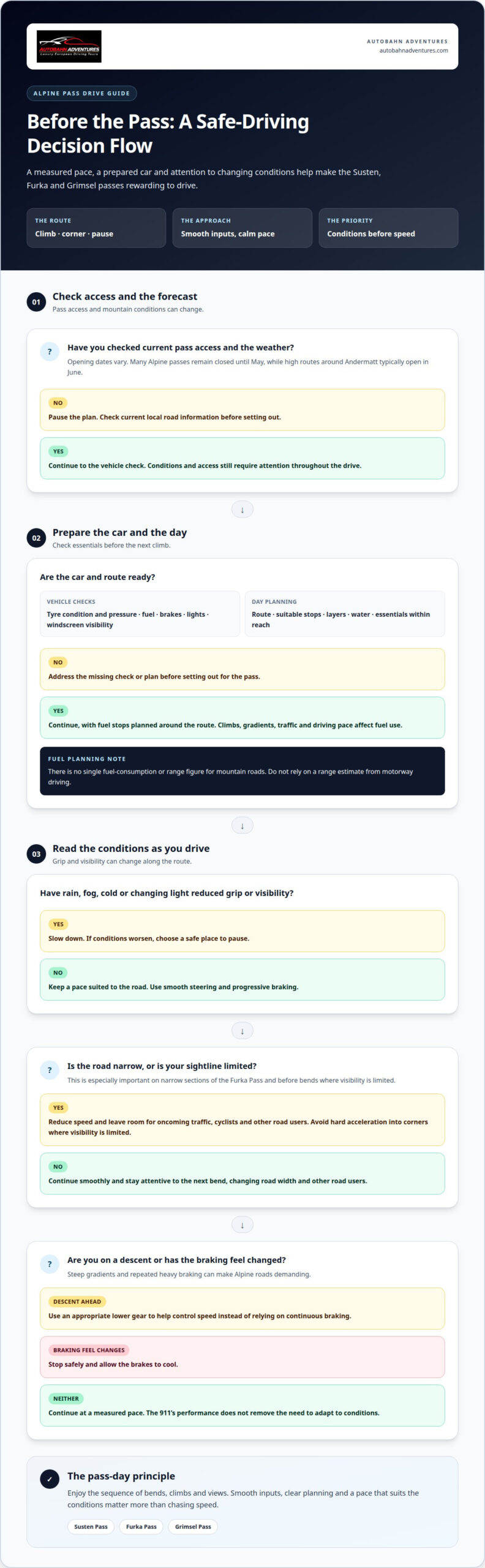
Season matters. Many Alpine passes remain closed until May, while high routes around Andermatt typically open in June. Snow, weather and local road conditions affect access, so opening dates vary. Toll arrangements and driving restrictions also differ by pass and country. Check current local road information before setting out, especially if your route crosses several passes.
There is no single fuel-consumption or range figure for a 911 on mountain roads. Elevation changes, gradients, traffic, driving pace and the car’s configuration all influence fuel use. Repeated climbs and acceleration can increase consumption compared with steady cruising. Plan fuel stops around the route, rather than relying on a range estimated from motorway driving.
Before setting out for the Susten Pass, prepare the car and plan the day’s route. Check tyre condition and pressure, fuel, brakes, lights and windscreen visibility. Review the forecast and pass access, then identify suitable stops before the next climb. Pack layers for changing temperatures, and keep water and essentials within reach during the drive.
- Choose a calm pace. Use smooth steering and progressive braking on tight bends. Avoid accelerating hard into corners where visibility is limited.
- Manage descents. Use an appropriate lower gear to help control speed, rather than relying on continuous braking. If braking feel changes, stop safely and allow the brakes to cool.
- Respect road width. On narrow sections of the Furka Pass, reduce speed where sightlines shorten. Leave room for oncoming traffic, cyclists and other road users.
- Adapt to conditions. Rain, fog, cold and changing light can reduce grip or visibility. Slow down and choose a safe place to pause when conditions worsen.
Steep gradients, tight turns and limited sightlines make Alpine roads demanding. Repeated heavy braking can cause brake overheating, while wet or cold surfaces can reduce available grip. The 911’s performance doesn’t remove those risks; smooth inputs and a pace suited to conditions remain essential.
On the Susten, Furka and Grimsel passes, the appeal lies in the succession of bends, changing elevations and open mountain scenery. Drivers often value a car that feels composed through corners and responsive at lower speeds. Each pass feels different depending on conditions and traffic, so leave room to enjoy the road rather than chase speed.
Which Porsche 911 models and trims are best suited to Alpine driving?
The right 911 depends on the kind of Alpine journey you want. A Carrera suits drivers seeking a balanced touring character, while an open-top 911 adds fresh air and changing mountain scenery to the drive. Rear-wheel-drive and all-wheel-drive versions also have different driving characteristics. No single configuration suits every driver or pass.
For a day linking the Susten, Furka and Grimsel passes, comfort and confidence matter alongside performance. Consider your preferred driving style, whether you enjoy open-air motoring, and how the car feels through frequent bends. A 911 that feels engaging at a measured pace can make a scenic touring day more rewarding than choosing solely for headline performance.
Match the 911 to the journey
The Carrera is a natural reference point for touring, while an open-top configuration brings the Alpine landscape into the experience. Because weather can change, being able to close the cabin is useful during a full day on the road. The right choice depends on which qualities matter most across your entire route.
Different 911 configurations bring different priorities. Rather than assuming one is automatically superior on mountain roads, consider the route and your preferred driving style. A varied touring itinerary calls for a different emphasis than a day devoted to spirited driving. The most suitable car is one that feels composed and enjoyable at the pace conditions allow.
- For touring: consider the Carrera’s balanced character as a starting point for mountain routes.
- For open-air motoring: consider whether you’d enjoy experiencing the changing scenery with the roof open.
- For drivetrain preference: weigh the distinct feel of rear-wheel drive and all-wheel drive against your comfort and route.
- For a focused drive: consider whether a performance-oriented setup suits a scenic touring day.
On Alpine passes, visibility, road width and changing conditions shape the experience more than a trim badge. A driver who prefers relaxed progress may want a different setup from one who enjoys a more focused feel. Passenger comfort and luggage needs also matter on a multi-day itinerary. Consider the complete journey, not just one climb or corner.
If you’re weighing a 911 for an Alpine itinerary, share your driving preferences to discuss the journey you have in mind.
How does the 911’s handling, braking, and traction compare with other sports cars on mountain roads?
On the Susten Pass, a sports car’s character emerges through successive bends, not just acceleration. The 911’s rear-engine layout gives its handling a distinct feel compared with front-engine sports cars. Drivers experience weight transfer as they brake, turn and accelerate. For those assessing Porsche 911 performance on Alpine passes, smooth inputs and a measured pace are central to enjoying its response.
No layout makes the 911 automatically better or worse than every other sports car. Steering response, drivetrain and road conditions all shape how a car feels. A lighter or differently configured sports car may communicate its balance in another way. On the Furka Pass, a clear view through each bend and a controlled line matter more than speed.
Braking requires care through a series of tight turns, such as on a descent of the Grimsel Pass. Brake progressively before a bend, hold a steady line through it, then accelerate gently as the road opens. Avoid entering corners too fast. If braking feel changes after sustained use, stop in a safe place and let the brakes cool.
Traction depends on the road surface, tyres, weather and driver inputs. Dry pavement feels different from a cold, shaded or wet section. Rear-wheel drive and all-wheel drive deliver power differently, but neither creates grip where little is available. On a damp Susten Pass, applying the throttle gradually helps avoid abrupt changes in balance.
- Approaching a bend: reduce speed beforehand, look toward the exit and steer smoothly.
- Descending: maintain a measured pace and avoid continuous, forceful braking.
- Meeting changing surfaces: make steering, braking and throttle inputs gradual.
These principles apply to any performance car, from a 911 to a mid-engined coupe. Compare how each car communicates grip and responds to measured inputs, rather than relying on its badge. A driver accustomed to one sports car may need time to adapt to another’s balance. On the Furka Pass, traffic, visibility and surface conditions can alter the ideal line from one corner to the next.
Porsche 911 performance on Alpine passes is best appreciated within the limits of the road. Leave room to respond to oncoming traffic, cyclists and narrowing bends. Adjust your pace when visibility or grip changes. The Susten, Furka and Grimsel passes reward attention and control, making a smooth, considered drive more satisfying than testing a car’s limits.
How does rear-wheel drive compare with Porsche’s all-wheel-drive 911 models on Alpine passes?
On a dry stretch of the Susten Pass, rear-wheel drive gives the driver a direct connection between throttle input and the rear wheels. The layout can make corner exits feel engaging, especially with smooth acceleration. Porsche’s all-wheel-drive 911 models also send drive to the front axle. That added driven-wheel contact can help the car put power down when grip varies.
The difference is most noticeable when conditions change, not as a simple ranking of one layout over another. A dry, clear road may let a rear-wheel-drive 911 feel precise and involving. A damp patch, cold shade or loose surface can make the additional traction of an all-wheel-drive model useful. Neither layout creates grip where the road has little available.
On the Furka Pass, tight bends call for gentle throttle as the road opens. With rear-wheel drive, abrupt acceleration can unsettle the rear tyres, particularly on a slippery surface. All-wheel drive can distribute power across both axles to help the car move away smoothly. Drivers still need to modulate the throttle and should not treat traction as permission to drive faster.
Braking and cornering remain governed by tyres, road surface, speed and driver inputs. All-wheel drive does not shorten every stop, and rear-wheel drive does not prevent composed cornering. On a descent toward Andermatt, brake before a bend and keep steering inputs progressive. That approach gives either 911 configuration a calmer transition through the corner.
- Choose rear-wheel drive if you value a traditional, connected feel on dry roads and enjoy measured throttle control.
- Consider all-wheel drive if your route may include changing grip and you value drive reaching both axles.
- With either layout, slow for wet or shaded sections, leave room for traffic, and accelerate progressively after bends.
For a touring route across the Susten, Furka and Grimsel passes, consider the likely conditions and your driving preferences together. A rear-wheel-drive car can make a clear, dry climb feel wonderfully involving. An all-wheel-drive 911 may offer welcome traction when the surface is less consistent. The more suitable choice depends on the route, weather and the driver’s comfort with each layout.
Whichever 911 you drive, smooth inputs matter more than exploiting its drivetrain. Keep a steady pace through a sequence of bends, leave space for oncoming vehicles, and adjust promptly when visibility or grip changes. For an Alpine journey shaped around your preferred driving style, discuss your mountain-driving plans.
Autobahn Adventures: Luxury European Porsche Driving Tour
Autobahn Adventures brings Alpine-road knowledge into a professionally organized Porsche driving holiday. For travellers drawn to mountain passes, the 2027 Peaks & Passes itinerary offers a focused way to experience the Susten, Furka and Grimsel passes behind the wheel of a Porsche 911. The route connects the pleasure of driving with the changing scenery of the Swiss Alps, without leaving guests to build the journey themselves.
This is a natural next step if you want more than a single pass drive and prefer a coordinated European touring experience. The Luxury European Porsche Driving Tour also suits travellers who want a Porsche-led journey through Europe. Explore the itinerary that best reflects your plans, then contact Autobahn Adventures to discuss your driving-tour interests.
Choose the journey that fits your driving style
Understanding Porsche 911 performance on Alpine passes is a starting point for shaping a European driving holiday around the roads you most want to experience. Consider whether your next trip should focus on mountain scenery or carry you through a wider variety of regions. The route, pace and overall character of the journey can make the difference between simply driving through Europe and enjoying each stage as part of a considered itinerary.
Autobahn Adventures offers the 4 Country Adventure and Peaks & Passes for travellers planning a Porsche-led European escape. Explore the journeys and consider which best matches your interests, whether winding Alpine roads are the main attraction or one highlight among several. A thoughtfully chosen itinerary lets the anticipation begin well before the first mountain bend.
Discuss your European driving plans with Autobahn Adventures, and take the next step toward a journey shaped around the roads you love.
Frequently Asked Questions
How does a Porsche 911 perform on steep, winding Alpine passes?
A Porsche 911 feels engaging on steep, winding passes because it responds to measured steering and throttle inputs. Its performance is best enjoyed by keeping a smooth rhythm, rather than accelerating hard between corners. On a climb such as Switzerland’s Susten Pass, use a pace that leaves time to read the road and respond to traffic. Select a suitable gear before steep sections, and keep attention on the next turn.
What are typical road conditions and speed limits on Alpine passes in Switzerland, Austria and Italy?
Conditions and posted limits vary across Switzerland, Austria and Italy, and may change from one road section to the next. Alpine routes can have narrow lanes, sharp bends, uneven surfaces, wet patches or reduced visibility. Weather and seasonal access can also affect individual passes. Follow posted signs and temporary notices throughout the drive. Do not assume one speed limit applies across an entire route or country.