
Already abroad? If you’re applying for an International Driving Permit, plan ahead and check the application requirements before you travel. It can’t be issued or mailed internationally, so timing matters for stress-free international driving. An IDP doesn’t replace your current national driving licence; you must carry both.
It’s easy to focus on the excitement of the route and leave document details until later. A little preparation helps you set off with greater confidence and leaves room to enjoy the journey.
You’ll learn which driving and travel documents to review, how to balance a clear itinerary with flexibility, and what an IDP does. This guide explains how the permit works alongside your national licence, so you can prepare before departure and focus on the scenery ahead.
Key Takeaways
- If you need a U.S.-issued International Driving Permit, apply while you’re physically in the United States; it can’t be issued or mailed internationally.
- Review your passport, national driving licence, and destination requirements before departure so you know which documents to carry.
- An International Driving Permit translates your national licence, but it doesn’t replace it. Carry both when driving.
- Build a flexible itinerary with planned essentials and room for scenic detours or unexpected delays.
- Save key travel details for offline access, and leave breathing room between major travel connections.
1. Checking for your wallet and driving documents
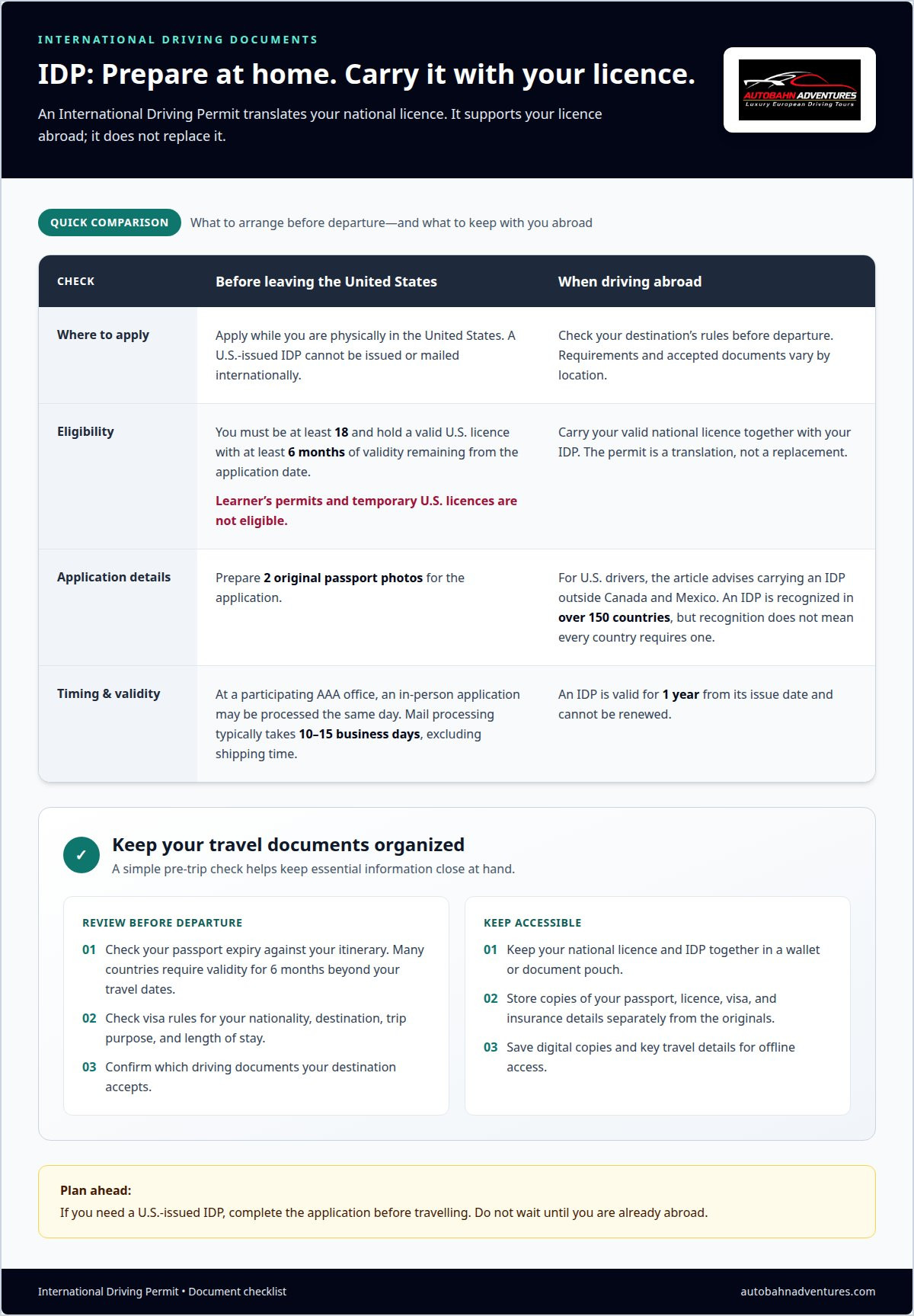
For travel abroad, U.S. drivers should carry a valid U.S. licence and, outside Canada and Mexico, an International Driving Permit (IDP). The IDP supplements your national licence, so keep both together in your wallet or document pouch. In Germany, foreign drivers must carry a valid national or international driving permit with the underlying national licence, according to Gesetze im Internet. Check the destination’s requirements before departure, since accepted documents vary by location.
Review your passport’s expiry date against your itinerary. Many countries require it to remain valid for six months beyond your travel dates. Check visa rules for your nationality, destination, trip purpose, and length of stay. If you expect repeated visits to a country requiring a visa, you may consider a multi-year visa instead of a normal 90-day visa. Keep copies of your passport, licence, visa, and insurance details separate from the originals, and save digital copies for access if a document is misplaced.
Prepare your IDP before leaving the United States. Your U.S. driver’s licence must have at least six months of validity remaining from the application date. Applicants need two original passport photos, must be at least 18 years old, and must apply while physically in the United States. Learner’s permits and temporary U.S. licences aren’t eligible. An in-person application at a participating AAA office may be processed the same day; mail processing typically takes 10 to 15 business days, excluding shipping time. Don’t leave this step until you’re already abroad.
Before booking flights, compare your bag’s size with the specific airline’s carry-on limits. International airlines may have stricter limits than U.S. airlines. Read the airline’s travel information for baggage rules and restrictions, then pack essential documents somewhere easy to reach. Save boarding details and reservations on your phone for offline access.
For a rental car, the rental agreement sets out fees, fuel-return terms, toll handling, and whether cross-border travel is permitted. Read those clauses together with your planned route, and note any permission or procedure required before crossing a border. Before setting out, check tire inflation and vehicle fluids. Confirm that the spare tire or roadside assistance information is accessible, and locate the required safety equipment. These simple checks help prepare you for an adventure without relying on an unnecessary 100-point inspection.
2. Balancing trip planning with flexibility
A successful road trip needs firm anchors and open spaces. Set your destination, overnight stops, and timed reservations in advance, then leave part of each day uncommitted. That gives you room to pause at a mountain viewpoint, explore a town, or adjust your route when weather or traffic changes your plans. Keep your driving licence and travel documents together, so a spontaneous detour doesn’t turn into a search through your luggage.
Decide which details need to stay fixed before departure. For example, reserve accommodation for nights when nearby events may limit options, and keep other stays flexible if your route allows. If you choose refundable lodging, read the cancellation terms and deadlines before booking. Save confirmations on your phone for offline access, and keep a simple itinerary with addresses and arrival dates. This protects important plans without making every roadside stop feel like a deadline.
Airport connections deserve their own time buffer. Road construction and accidents can delay transfers, so avoid scheduling a tight drive immediately before a flight. For a Paris station transfer, one traveler added about 30 minutes to the suggested taxi departure time. Use the same principle for an airport journey: consider the route, likely congestion, luggage, and the time needed for airport procedures. If you leave the airport during a layover, plan your return with security and other departure steps in mind.
A long layover can become part of the adventure when the timing works. One traveler with a 10-hour stop in Dubai booked a half-day walking tour. Before making a similar plan, map the airport-to-city journey and the return trip, then allow time for check-in and security. Major airports often offer luggage storage and may sit a short distance from city centers. Check storage arrangements and tour timing before leaving your bags or the terminal.
Plan scenic stops, but don’t put every pause on the clock. Mark a few landmarks, local attractions, towns, and lookout points along the route. A coastal highway may invite a longer stop than a countryside lane, while a mountain pass may require more attention to changing conditions. Choose a sunrise or sunset viewpoint if it fits your route, and keep a nearby alternative in mind. Your plan should guide the day, not prevent discovery.
For a European driving itinerary, decide which experiences matter most, then leave space between them. If you’d like help shaping the route around your travel plans, share your itinerary preferences.
3. What is an International Driving Permit (IDP)?
An IDP translates a national driving licence into multiple languages. It supports your licence abroad, but doesn’t replace it, so carry both when driving. An IDP is recognized in over 150 countries, though recognition doesn’t mean every country requires one. Rules depend on your destination, nationality, and licence type.
For U.S. drivers, an IDP is required in some destinations and recommended for international travel where rental companies or local authorities may request one. Apply through an authorized U.S. issuer while physically in the United States. You must hold a valid U.S. licence with at least six months of validity remaining from the application date. The permit is valid for one year from its issue date and can’t be renewed.
Country rules differ. France and Germany require drivers with non-EU licences to supplement them with an IDP. In Germany, carry the IDP with the underlying national licence. Brazil requires foreign drivers to have an IDP. Japan requires the 1949 Geneva Convention model; according to Japan’s National Police Agency, either accepted licence option is valid for up to one year from entry, while the licence itself remains valid. In the United Kingdom, visitors may drive with their national licence for up to a year. Check the destination’s rule before planning routes.
Renting a vehicle abroad involves separate rental terms. Minimum age, licence requirements, and accepted credit cards depend on the country, rental company, and vehicle category. Read the rental agreement for the exact conditions, including whether an IDP is required. If you’re renting an electric vehicle, plan charging stops along your route and confirm the rental’s charging instructions before setting out.
Choose insurance suited to your destination, vehicle, trip duration, and preferred coverage limits. International driving coverage costs vary with these factors, so there’s no single price for every trip. Before collecting the vehicle, understand what the policy covers, which exclusions apply, and how to report an incident.
Local rules also vary by country. Learn the road signs and speed limits for each destination, rather than assuming U.S. conventions apply. For example, European road hazard warnings are triangular, while American warnings are diamond-shaped. In Japan, the required IDP model is tied to the 1949 Geneva Convention.
Driving on the left, using a manual transmission, or navigating unfamiliar road layouts can require extra attention. Before departure, review your route and vehicle controls, then allow time to adjust in a quiet area. Driving without required documents can leave you unable to meet a destination’s rules; penalties depend on local law. Keep your national licence and any required permit together, and understand your insurance terms before driving.
4. What an International Driving Permit is and how it works
An International Driving Permit (IDP) is a multilingual document that translates a national driving licence, helping make licence information readable across language barriers. It isn’t a replacement for your current licence: keep both documents together and present them as a pair. The practical takeaway is simple: an IDP supports your existing licence; it doesn’t stand alone.
For U.S. drivers, the U.S. Department of State authorizes two organizations to issue IDPs. Apply through an authorized issuer before leaving the United States, while you’re physically there. An IDP can’t be issued or mailed internationally. If you’re already abroad without one, check the destination’s requirements and plan accordingly. Plan your application around your departure, not your arrival at the rental counter.
Use the destination’s rules to decide whether an IDP is required. Recognition in over 150 countries doesn’t make the permit a universal driving authorization. Requirements vary by country and may depend on the licence you hold. Japan, for example, requires the 1949 Geneva Convention model. The permit’s format matters, so identify the required model before applying rather than assuming every IDP is interchangeable.
Keep your IDP accessible with your national licence, especially when collecting a vehicle or driving between countries. Store the originals together in a secure document holder, with digital copies stored separately for reference. Digital copies don’t replace the required physical documents. Before rental pickup, gather your passport, licence, IDP, booking details, and payment card. A rental agreement may require a credit card, but it doesn’t replace your driving documents.
Check that the details on your permit match your national licence, including your name and licence information. Address any errors before travelling. Keep the permit’s validity period in mind: an IDP is valid for one year from its issue date and cannot be renewed. If your trip extends beyond that period, plan ahead and check how to arrange a permit before you travel.
At a checkpoint or rental desk, present your IDP alongside the original licence, not instead of it. Follow local driving requirements too; a translation doesn’t change the rules. For example, an IDP doesn’t remove the need to understand local signs, road markings, and vehicle rules before setting out. Keep both documents readily available rather than buried in your luggage.
For a European driving journey, thoughtful preparation can leave more attention for the road and scenery. Discuss your European driving plans as you shape an itinerary.
Autobahn Adventures: 2027 Monaco Grand Prix VIP Tour
Autobahn Adventures combines European driving with a distinctive route to the Monaco Grand Prix. After the driving portion, guests fly to Barcelona, Spain, then board a Mediterranean cruise ship sailing to Monaco for the race. The 2027 Monaco Grand Prix tours are sold out, so this itinerary is not available to book.
If you’re planning a future European road adventure, explore the 4 Country Adventure or Taste of Tuscany . Each offers a different way to experience Europe behind the wheel. For race-day travel, the British Grand Prix VIP Tour follows its own itinerary, with the driving portion beginning in Germany, Austria, and Switzerland after the race.
Contact Autobahn Adventures to discuss its European driving tours and find an itinerary that suits your travel plans.
Let the road shape your next journey
Stress-free international driving begins with choosing a journey that reflects how you want to experience Europe. You might favor sweeping scenery, time behind the wheel, or a major event woven into your travels. Set your priorities first. They can guide your route and help you choose an itinerary that feels right.
Autobahn Adventures offers Luxury European Porsche Driving Tours . The 2027 Monaco Grand Prix VIP Tour brings driving and race-week travel together. These are distinct ways to explore Europe, with different experiences at the heart of each itinerary. For stress-free international driving, choose the journey that best matches your interests and pace.
Give yourself time to consider what you’d most like to discover on the road. Contact Autobahn Adventures to discuss your European driving plans. Your next memorable journey can begin with a thoughtful choice.
Frequently Asked Questions
Can I apply for an IDP if I’m already abroad?
No. You must apply for a U.S.-issued IDP while physically in the United States, and it can’t be issued or mailed internationally. If you’re already overseas without one, don’t assume a digital copy or another document will substitute. Check the destination’s driving requirements before taking the wheel, and apply in person in the United States before a future trip.
Can I use an IDP on its own?
No. An IDP isn’t a standalone driving licence. It supports the national licence it translates, so keep your original licence with it and present both when required. For example, showing an IDP at a rental counter without your national licence means the essential licence document is missing. Keep the pair together in your document holder, not in separate bags.
What is an International Driving Permit (IDP)?
An IDP is a document that translates information from your national driving licence into multiple languages. It helps officials or rental staff understand your licence, but it doesn’t grant driving privileges beyond those provided by your underlying licence. The required permit model can differ by destination. Japan, for example, requires an IDP issued under the 1949 Geneva Convention model.
What is an international driver’s license?
“International driver’s license” is a common informal name for an International Driving Permit, but an IDP isn’t a separate licence. It’s a translation document used alongside your valid national licence. Treat claims of a standalone international licence carefully: your national licence remains the underlying credential. Carry the original, not just a translation or photocopy.
What to remember?
Keep your national licence and IDP together, and make sure you have the permit model required for your destination. Before collecting a vehicle, keep your passport, rental confirmation, and payment card somewhere easy to reach. Store copies of key records separately from the originals. A simple document check before leaving your accommodation can prevent a last-minute search at a border or rental desk.
How much does an International Driving Permit cost, and how long is it valid?
Application costs depend on the issuing channel and any delivery arrangements, so include those details in your plans. A U.S.-issued IDP is valid for one year from its issue date and cannot be renewed. If your travel plans extend beyond that period, time your application closer to departure while allowing enough time for processing and delivery.