
What if the best way to share your enthusiasm for a driving vacation is to start by listening, not persuading? If you’re wondering how to convince your spouse on a driving vacation, their hesitation deserves a thoughtful conversation. A trip through Europe may sound like long days behind the wheel, unfamiliar roads, or unclear costs. Those concerns matter, especially when you want the vacation to feel like time together, not a schedule built around one person’s passion.
You don’t need to turn the conversation into a sales pitch. Explore what feels appealing, what gives your spouse pause, and what would make the experience more comfortable for both of you. A European driving tour can pair legendary roads with luxury hotel stays and planned experiences, leaving room for scenery, discovery, and time to unwind. The goal isn’t simply a yes. It’s a decision you can both feel good about, whether that means planning together, revisiting the idea later, or choosing something else.
Key Takeaways
- Treat hesitation as useful insight into your spouse’s comfort, interests, and expectations, not as an objection to overcome.
- Compare each partner’s must-haves, preferences, and deal-breakers across driving time, scenic stops, cultural experiences, hotel comfort, and downtime.
- Use a simple conversation: ask, listen, share your excitement in first-person terms, then decide together without pressure.
- To explore how to convince your spouse on a driving vacation, compare itinerary details with the priorities you’ve both identified.
- Consider how a European tour can pair Porsche 911 driving with luxury hotels and planned experiences, rather than centering every moment on the road.
Address Hesitation to Plan a Driving Vacation
Your excitement about a driving vacation doesn’t obligate your spouse to agree. A pause isn’t a challenge to overcome. It’s useful information about what would make a trip enjoyable, or what might make it uncomfortable. A good travel decision begins by understanding both partners’ priorities.
Identify the specific concern before suggesting a solution. One spouse may enjoy driving but worry about long days behind the wheel. Another may feel uneasy about unfamiliar roads or worry that scenic stops and sightseeing will leave too little time to relax. These are different reservations, and they call for different conversations.
Driving vacations can also mean different things to each person. One partner may picture open roads and the freedom to explore. The other may hope for cultural experiences, a comfortable place to unwind, or more time in fewer destinations. Budget concerns deserve to be heard on their own terms, too. They don’t automatically signal a lack of interest. Exploring the history and motivations of road trips can offer a wider perspective, but your spouse’s own preferences matter most.
What might be behind a spouse’s hesitation?
Separate the idea of driving from the details of the itinerary. Ask whether the concern is driving itself, the length of each day, or navigating unfamiliar roads. Then consider comfort, cultural stops, and downtime. A spouse who wants time to relax may be open to a trip that balances time on the road with experiences beyond it. Start with their actual concern, not a guess.
Listen before making the case
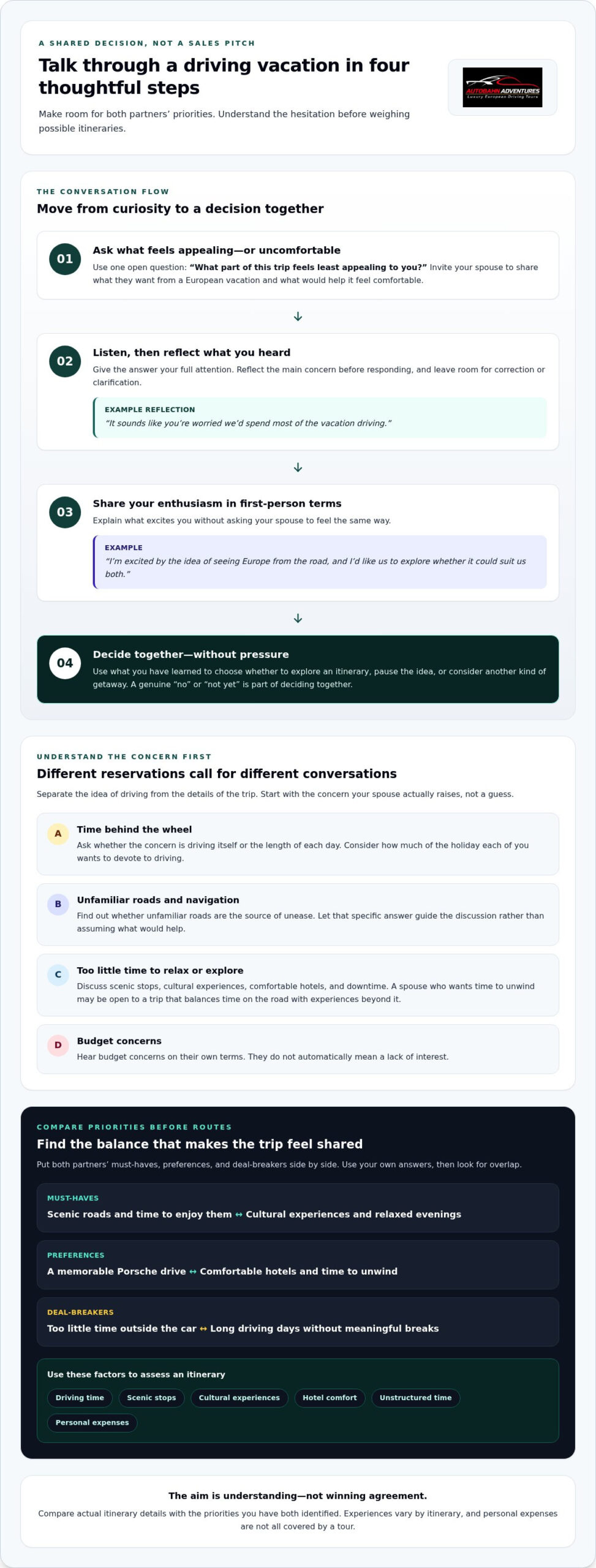
Begin with one open question: “What part of this trip feels least appealing to you?” Listen without preparing a rebuttal. Then reflect what you heard: “It sounds like you’re worried we’d spend most of the vacation driving.” Give your spouse room to correct or clarify before discussing possibilities.
Only then share your perspective. Use first-person language, such as, “I’m excited by the idea of seeing Europe from the road, and I’d like us to explore whether it could suit us both.” This approach to how to convince your spouse on a driving vacation keeps the conversation honest, not sales-driven. A genuine no or not-yet answer is part of deciding together. You can pause, revisit the idea later, or choose another kind of getaway.
Make a European driving vacation feel like a shared escape
A shared trip takes shape when both partners can see their priorities in it. Put those priorities side by side before comparing destinations or routes. Keep the list practical: include what each of you hopes to experience, what would make the trip comfortable, and what could make it a poor fit.
| Partner A | Partner B |
|---|---|
| Must-have: scenic roads and time to enjoy them | Must-have: cultural experiences and relaxed evenings |
| Preference: a memorable Porsche drive | Preference: comfortable hotels and time to unwind |
| Deal-breaker: too little time outside the car | Deal-breaker: long driving days without meaningful breaks |
Use your own answers, not these examples. Then look for overlap. Perhaps one person values the route while the other cares most about local experiences and downtime. A road vacation can hold both, but the balance matters. Compare driving time, scenic stops, cultural experiences, hotel comfort, and unstructured time. Ask how much of the holiday each of you wants to devote to driving, and which shared interests deserve space in the plan. Planning a road trip with Recreation.gov can offer practical planning ideas, even though its guidance focuses on U.S. destinations.
Find the overlap between driving and downtime
Don’t make the car the whole story. A Porsche can be an exhilarating part of a European escape, while the scenery, places you explore, and time together shape the rest. Consider comfort and shared interests alongside the route. If you both want beautiful landscapes but differ on how much driving feels enjoyable, use that preference to assess whether an itinerary suits you.
Describe the experience accurately
Autobahn Adventures tours feature the latest model Porsche 911 Carrera, luxury hotel accommodations, and planned experiences. Experiences vary by itinerary, so compare the actual details rather than imagining a particular attraction, car variant, or daily schedule. The all-inclusive Porsche vacation guide offers a starting point for picturing the journey. Read the details carefully: personal expenses are not all covered by a tour.
This is a more useful way to explore how to convince your spouse on a driving vacation: build the idea around what you both value, rather than asking one person to adopt the other’s dream. If you’d like to talk through the priorities that matter to you as a couple, share your travel priorities with Autobahn Adventures.
How to discuss a driving vacation without turning it into a sales pitch
A thoughtful conversation leaves room for curiosity and hesitation. The aim isn’t to win agreement. It’s to understand whether the trip could suit you both. Use four steps, and let each one breathe before moving on.
- Ask. Invite your spouse to share what they’d want from a European vacation. Ask what sounds appealing and what would make the trip feel comfortable.
- Listen. Give their answer your full attention. Reflect the main point before responding, so they can tell you whether you’ve understood correctly.
- Share. Explain your enthusiasm in first-person terms: “I’d love to experience the scenery from the road.” Don’t imply your spouse should feel the same.
- Decide together. Consider what you’ve learned, then choose whether to explore an itinerary, pause the idea, or move on to another kind of vacation.
Share the idea with clarity and room for questions
Describe why the trip appeals to you, then invite your spouse’s perspective. If you share itinerary details, present them as information to consider, not evidence that they should agree. A curated European driving tour experience combines time behind the wheel with accommodations and planned experiences. Details vary by itinerary. Let questions guide what you discuss next, rather than treating reservations as obstacles to defeat.
Discuss expectations and practical boundaries
Talk about pace, shared activities, and each person’s comfort. Review the itinerary together and distinguish what the tour includes from costs and arrangements that remain yours. International airfare and personal expenses are not included in tour pricing. Personal expenses include items such as phone calls, room service, laundry, excess kilometres, and meals or beverages not listed in the itinerary. Travelers arrange and pay for their own air travel and obtain their own health, accident, baggage, and trip-cancellation insurance. Travel insurance is strongly recommended.
Be clear about the financial commitment, too. A $10,000 per-couple deposit is required to secure a place on the guest list. Final payment is due 120 days before the tour starts, unless a specific tour states otherwise, and final payments are non-refundable. Reviewing these details together helps both partners assess the experience realistically. If you’d like to discuss what matters to you as a couple, share your priorities with Autobahn Adventures, without asking your spouse to commit before they’re ready.
Turn mutual interest into a considered European driving vacation
Once you’ve identified what matters to both of you, use those priorities to assess actual itinerary details. Look at the driving and planned experiences side by side. If one partner values scenic roads and the other wants cultural discovery and comfortable stays, consider how each itinerary addresses those interests. Don’t assume a tour will resolve a concern unless its stated details support that conclusion.
Use shared priorities to assess a curated tour
Autobahn Adventures’ 2027 European itineraries combine driving a latest model Porsche 911 Carrera with luxury hotel accommodations and planned experiences. Specific details vary by itinerary. Browse the European driving tours together and compare what each one describes with the priorities you named. Notice the balance of driving and planned activities, and discuss any detail that feels especially appealing or gives either of you pause.
Be precise about what the tour covers. “All-inclusive” refers to the listed tour elements, not every cost or arrangement. International airfare and personal expenses are not included. Travelers arrange their own air travel and obtain their own insurance. Travel insurance is strongly recommended. Keeping this information in view helps you make a considered decision without assuming every expense or preference is automatically covered.
Choose a next step that feels comfortable to both
After reviewing an itinerary, agree on a next step. You might want to explore the details further, revisit the idea later, or choose a different kind of vacation. Each is a reasonable outcome. A shared interest doesn’t require an immediate commitment, and an itinerary should fit both partners, not simply match one person’s wish list.
This is the practical heart of how to convince your spouse on a driving vacation: make space for a decision that belongs to both of you. If you’re both interested in exploring whether a 2027 itinerary aligns with your priorities, discuss a European driving vacation with Autobahn Adventures. A thoughtful conversation can help you decide whether the road ahead feels inviting to you both.
Let a shared decision shape the next journey
The best answer to how to convince your spouse on a driving vacation may be a conversation that changes the question. Instead of asking how to secure a yes, consider what would help you both choose with confidence. A pause can create room to compare what you value, refine the idea, or discover that another kind of escape suits you better.
If you’re both curious, take one small next step. Choose an itinerary to review together, then note what excites you and what still needs discussion. There’s no need to settle every detail in one sitting. The aim is to find a possibility that feels inviting to both of you, not to persuade one partner to follow the other’s plan.
Explore a 2027 European driving vacation together and discuss how your shared priorities might shape the journey. Whether you’re ready to explore or simply want to understand the possibilities, a thoughtful next step can bring the road ahead into clearer view.
Frequently Asked Questions
How do I convince my spouse to take a driving vacation without pressuring them?
Invite your spouse to explore the idea with you, without asking for an immediate yes. You could say, “I’m interested in this trip. Would you be open to looking at one itinerary together?” Make it clear that either of you can decide it isn’t the right fit. If you’re considering how to convince your spouse on a driving vacation, focus on a shared choice, not a winning argument.
What if my spouse says a driving vacation sounds like too much driving?
Ask what “too much” means to them. They may be concerned about consecutive driving days, the length of each drive, or missing time to explore. Review the itinerary’s driving details together and mark the parts that feel concerning. If the pace still doesn’t suit your spouse, take that seriously. A different itinerary or a different kind of vacation may be a better match for both of you.
Can a European driving vacation appeal to someone who is not a car enthusiast?
Yes. A shared trip doesn’t require both partners to have the same interest in cars. One person might look forward to the Porsche drive, while the other is drawn to Europe’s scenery, planned experiences, or relaxing at a luxury hotel. Each partner can choose a personal highlight to look forward to. The key is to find an itinerary with details that interest both of you.
How can couples decide whether a driving vacation is right for them?
Each partner can privately choose their three most important trip priorities, then compare the lists. Look for shared interests and any deal-breakers. Next, review an itinerary against those priorities, rather than judging the idea in the abstract. If a key concern remains unanswered by the itinerary details, pause before committing. A mutual “not yet” is a useful decision, not a failure to plan.
Does an all-inclusive driving tour include airfare and every travel expense?
No. “All-inclusive” refers to the tour elements listed for that itinerary, not every travel cost. International airfare and personal expenses are not included. Health, accident, baggage, and trip-cancellation insurance are also not provided. Travelers arrange their own air travel and insurance, and travel insurance is strongly recommended. Before deciding, review the itinerary’s inclusions and exclusions together so your shared budget reflects what you’ll arrange separately.
What is a good first step if we are both interested in a Porsche driving tour?
Choose a 2027 itinerary that appeals to you both, then read its details together. Each partner can note one highlight, one practical question, and anything that might affect comfort or pace. Autobahn Adventures tours feature the latest model Porsche 911 Carrera, but a specific variant isn’t guaranteed. Use the itinerary’s stated experiences and accommodations to decide whether its overall character fits your shared vision.