A familiar-looking road sign can still carry an unfamiliar meaning. On a winding European road, you may have only a moment to read a symbol, a line of text, or a small panel beneath it. Understanding european road signs starts with knowing what to notice first, then interpreting the sign in context.
Many signs share visual patterns, but local wording and rules can differ between countries. This guide explains how to identify common sign categories, what details to look for, and how to respond calmly when a sign is unclear. A little preparation can help you make decisions without taking your attention away from the road.
You’ll find practical ways to read signs, supplementary panels, and local variations. Before setting out, check current official guidance for each country on your route. That preparation leaves you better placed to focus on driving and enjoy the journey.
Key Takeaways
- Understanding european road signs starts with recognizing common categories, then considering the sign’s context.
- Use warning, priority, mandatory, prohibitive, information, and direction signs to guide your next safe driving decision.
- Read supplementary panels with the main sign. If its meaning isn’t immediately clear, avoid sudden stops or abrupt maneuvers.
- Before driving in a new country, review official route guidance, sign examples, and information about restricted access.
Are European Road Signs the Same Everywhere? Understand the Shared Patterns
European road signs use shared visual conventions, but countries can have their own wording, supplementary panels, and restrictions. A familiar shape or symbol is a useful first clue, not proof that every local detail is the same across borders.
That distinction matters when you’re driving. The design can suggest a sign’s broad purpose, while its wording, nearby panels, and position explain how it applies on that stretch of road. Understanding european road signs means considering both the shared visual language and the local context.
What makes European road signs recognizable?
Shape, color, symbols, and placement work together to make signs easier to scan. In broad terms, triangular signs often warn of hazards, circular signs commonly set instructions or restrictions, and rectangular signs often provide information. These patterns help you make a first assessment, but always read the sign itself.
The Vienna Convention on Road Signs and Signals provides a foundation for shared conventions among participating countries. It does not make every sign or national road rule identical. For a side-by-side view of national designs, the Comparison of European Road Signs highlights both common patterns and variations.
Recognizing a sign’s category helps you anticipate its purpose, but context determines how to respond. Look for the full symbol, any wording, and nearby supplementary panels. Then consider how the instruction relates to the road ahead.
Which details can change from country to country?
Local wording and supplementary panels can qualify a sign or explain where a restriction applies. Even when a symbol looks familiar, don’t assume its details match those in the country you’ve just left. Ireland, for example, uses yellow diamond-shaped warning signs, unlike the red-bordered triangular warnings common in much of Europe.
In Italy, ZTL refers to a limited traffic zone. Treat unfamiliar local terms as a cue to find out what restriction they indicate instead of relying on a guess. Access rules can depend on local details, so consult current official information for each country on your itinerary.
Before crossing a border, review official road guidance for your destination. Note any local terms or restrictions that affect your route. This small step can make unfamiliar signs easier to interpret and help you avoid rushed decisions at junctions or restricted-area entrances.
European Road Sign Categories: Recognize Warnings, Priorities, and Restrictions
Start by asking what the sign requires you to do. Does it call for caution, assign priority, set a restriction, or help you choose a route? Shape and color offer clues, but they are not guarantees across every country. Read the full sign and any accompanying panel before acting.
Warning, priority, and mandatory signs
These categories call for different responses. A warning sign signals a condition that needs attention. Look ahead and adjust your driving as appropriate. A priority sign affects who proceeds, so follow its instruction while remaining alert to other road users. A mandatory sign directs you to take a particular action. It is not simply a warning about a possible hazard.
- Warning: Notice a possible hazard or change in road conditions, then drive with suitable care.
- Priority: Check how the sign affects who should proceed, and respond with attention to other road users.
- Mandatory: Follow the required direction or action shown by the sign.
- Prohibitive: Identify the movement, access, or activity that the sign restricts.
- Information: Use the sign to understand nearby services, facilities, or road conditions.
- Direction: Read route and destination information early enough to make a calm turn or lane choice.
Prohibitive, information, and direction signs
Prohibitive signs communicate limits. Check what the restriction applies to and whether additional details appear below the main sign. Information signs point out facilities or conditions. Direction signs help you choose a route. Read both in relation to the road layout and any other posted instructions.
A supplementary panel qualifies the main sign by adding conditions, time periods, or vehicle-specific details. Treat it as part of the instruction, not optional background. For a useful reference to sign shapes, colors, and meanings in the UK, consult The Highway Code: Traffic Signs. This reference is specific to the UK, so use current official guidance for the country where you’re driving.
With practice, understanding european road signs becomes less about memorizing isolated symbols and more about recognizing the driving task each sign presents. If you’re planning a guided European drive, you can discuss your driving experience with Autobahn Adventures as part of your preparation.
How to Read an Unfamiliar Road Sign Safely While Driving in Europe
An unfamiliar sign can demand attention just when the road needs it. Keep your focus on driving first. Don’t stop in the carriageway or make a sudden turn to inspect a sign. Use a calm sequence to gather the visible clues and respond safely without guessing.
A simple sequence for interpreting signs
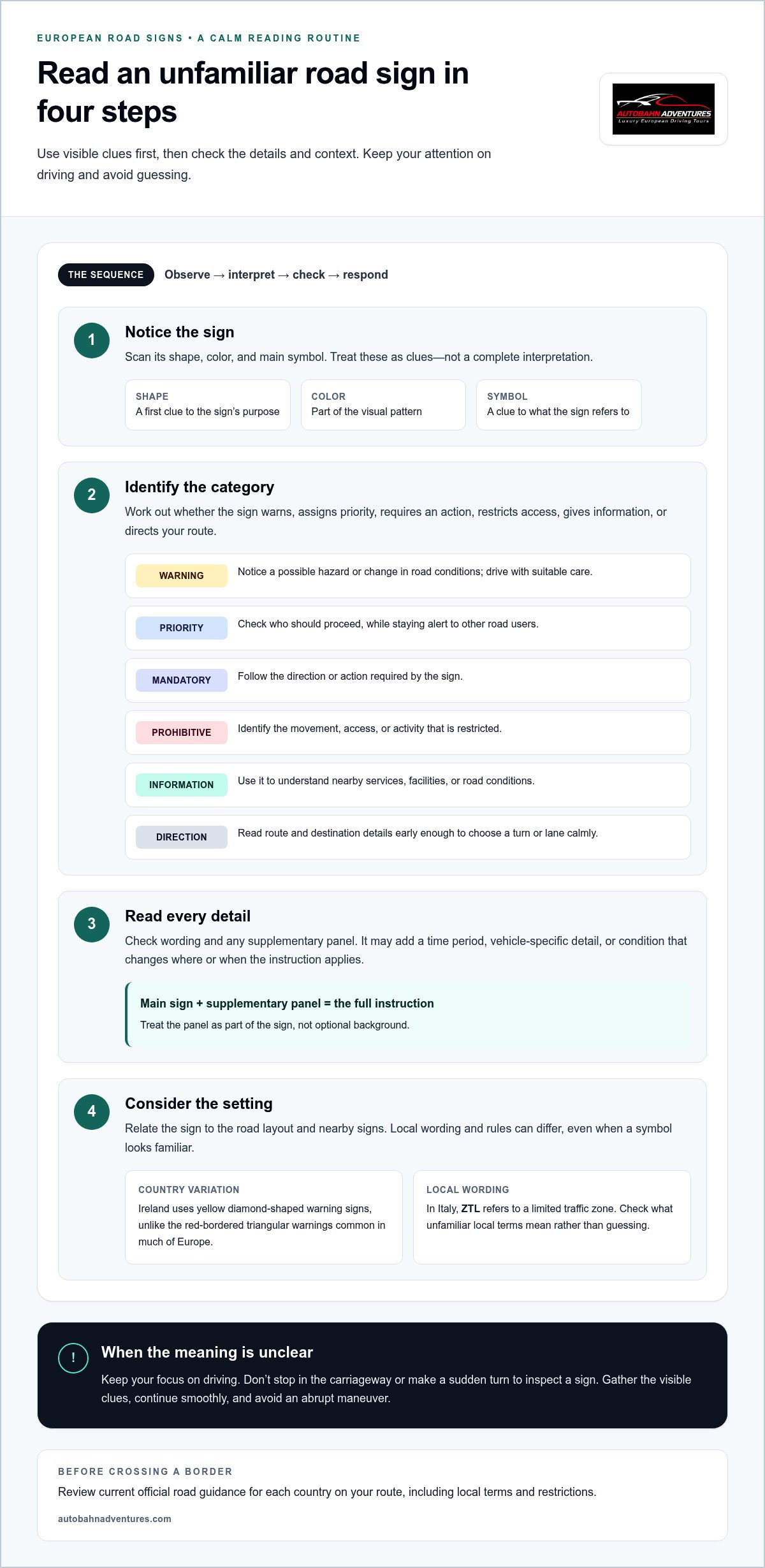
Use this order to make a quick first assessment. Understanding european road signs is easier when you separate observation from action:
- Notice the sign. Look at its shape, color, and main symbol. Treat these as clues, not a complete interpretation.
- Identify its category. Decide whether it warns, directs, restricts, or provides information. This narrows down the kind of response it may require.
- Read the details. Check any words or supplementary panel. A time period, vehicle description, or other condition may change where or when the instruction applies.
- Consider the setting. Look at the road layout and nearby signs. Continue smoothly and respond only when it’s safe to do so.
If you can’t read every detail at a glance, don’t try to solve it with a sudden maneuver. An unclear sign calls for a cautious, lawful response, not a guess. Keep control of the vehicle and follow the information you can safely understand.
Prepare for signs, parking, and restricted areas
Before setting out in each country, review current official driving guidance for your route. Pay particular attention to parking and restricted-access areas. Their signs may use local terms or panels to describe conditions, times, or permitted vehicles. Note unfamiliar wording in advance so you’re less likely to face a rushed decision at an entrance or junction.
A passenger can check a route note or official reference while you concentrate on the road. Agree on this role before departure. If you’re driving alone, review examples while parked before beginning the journey, and plan where you can safely pause if you need more information. Never read or search on a device while driving.
Preparing for an Autobahn drive also means planning ahead. For a guided European driving experience, talk with Autobahn Adventures about your driving plans.
Prepare for a European Drive with a Practical Road-Sign Routine
A short review before each country’s driving segment can make unfamiliar signs easier to process. Build a routine around your route, official guidance, and any areas where access may be restricted. Understanding european road signs is not just about recognizing symbols. It also means knowing where to find reliable details before you set off.
A pre-drive checklist for unfamiliar signs
Use this checklist before beginning a new stretch of your itinerary. It keeps research out of the driver’s hands once the vehicle is moving and gives everyone in the car a shared reference for local signs and route decisions.
- Review current official driving guidance for every country on your itinerary.
- Look at sign examples and note unfamiliar wording or panels.
- Identify likely restricted-access areas along the route, including relevant parking information.
- Save reliable references for offline access where practical.
- Agree that the driver watches the road while a passenger checks route details.
Turn preparation into a more considered driving experience
Preparation doesn’t need to be elaborate. A brief review at the start of each country’s segment can help you anticipate local sign details and keep your attention on the road. A passenger can handle route notes when needed. If you’re driving alone, review references before departure and wait until safely parked to consult them again.
For travelers who prefer a curated journey, European driving tours offer another way to experience the region by road. Autobahn Adventures’ all-inclusive tours feature the Porsche 911, with five-star hotel stays, gourmet meals, vehicle insurance, and luggage transportation included in the tour experience.
A considered itinerary brings together practical preparation and the pleasure of the drive. Review local sign guidance before setting out, and leave space in your plans to take in changing landscapes without leaving sign interpretation to the last moment. Explore the broader touring experience through Autobahn Adventures’ European Porsche driving tour guide, and use the same thoughtful approach when reviewing signs for each country.
Discuss a European driving experience with Autobahn Adventures as you plan your journey.
Set Out Ready for the Road Ahead
Before your next European drive, make country-specific sign guidance part of your route preparation. Keep a trusted reference close, review it before setting off, and give yourself time to absorb new road patterns as the scenery changes. Understanding european road signs is a skill that grows with attention and preparation, not a test of how quickly you can guess.
If you’d rather enjoy the journey with the larger details arranged, a guided drive offers a curated way to experience Europe. Autobahn Adventures’ European tours feature the Porsche 911, with vehicle insurance and luggage transportation among the tour logistics.
Choose a route that suits your interests, prepare for local signs, and make room to enjoy the drive. Explore a European driving journey with Autobahn Adventures.
Frequently Asked Questions
Are European road signs written in English?
No. Road-sign wording varies by country, and some signs rely mainly on symbols. Don’t assume an English translation will appear, even if the sign’s design looks familiar. Before departure, learn essential signs for your route, including terms related to directions, parking, and restricted access. For unfamiliar wording, consult current official guidance for that country. Treat symbols as helpful clues, not proof that a rule has the same meaning everywhere.
What does ZTL mean on an Italian road sign?
ZTL stands for Zona a Traffico Limitato, meaning a limited traffic zone. The term identifies a restricted area, but it doesn’t tell you the access conditions for every location. Local signs and current rules determine what applies. Before entering, read the posted information carefully, including any conditions or time details. If the instructions aren’t clear, consult official guidance for that specific area before driving in.
Do European road signs use miles or kilometres?
Units can differ between countries, so check the conventions for each part of your route. In the United Kingdom, the Highway Code presents speed limits in miles per hour, and road distances are generally shown in miles. Don’t assume the same unit applies throughout a multi-country drive. Before crossing a border, review official driving guidance and check your vehicle’s display so you can interpret posted limits and distances confidently.
Can a navigation app replace reading European road signs?
No. Navigation tools can support route planning, but they can’t replace your attention to posted signs and changing road conditions. Map information may not show every temporary diversion or local restriction. Use navigation before setting off, then keep your focus on the road while driving. Follow current posted information, and consult official country guidance when you need to understand a rule. A passenger can help review route details when appropriate.
What should I do if a European road sign is partly hidden or unclear?
Keep your attention on the road, avoid abrupt maneuvers, and don’t guess at an instruction. Maintain a safe course based on the information you can see and the surrounding conditions. If a passenger is present, they can help interpret the sign without distracting the driver. For a rule that remains unclear, stop only in a safe place and consult official guidance before continuing along the route.