What if the rear-engine architecture of a Porsche 911 is not a handling liability on steep switchbacks, but your greatest performance advantage? If you are looking for essential tips for driving a porsche 911 on mountain roads, you already know that carving high-altitude passes demands absolute respect for the car’s unique balance.
Staring down a sheer descent along Switzerland’s Susten or Grimsel Pass can test anyone’s resolve. It is natural to feel uneasy about lift-off oversteer on tight downhill hairpins, pedal fade on prolonged elevation drops, or awkward gear selection during steep climbs. However, unlocking this iconic machine simply requires working in harmony with its rear weight bias rather than fighting against it.
You will learn how to balance throttle and steering fluidly through technical switchbacks, safeguard your brakes, and manage elevation changes with complete composure. Here is your essential guide to mastering alpine curves and experiencing the full grand touring potential of the Porsche 911.
Key Takeaways
- Master how rear-engine physics enhances mechanical grip, allowing you to accelerate out of corners earlier and with greater stability.
- Implement proven tips for driving a porsche 911 on mountain roads to load the front tires properly before turning into tight hairpins.
- Prevent brake fade on demanding alpine descents by adopting cadence braking techniques instead of riding the pedal.
- Cultivate an effortless grand touring pace that keeps transmission temperatures low and elevates your journey across iconic passes like Susten and Grimsel.
Understanding Porsche 911 Dynamics: How Rear-Engine Physics Affects Mountain Handling
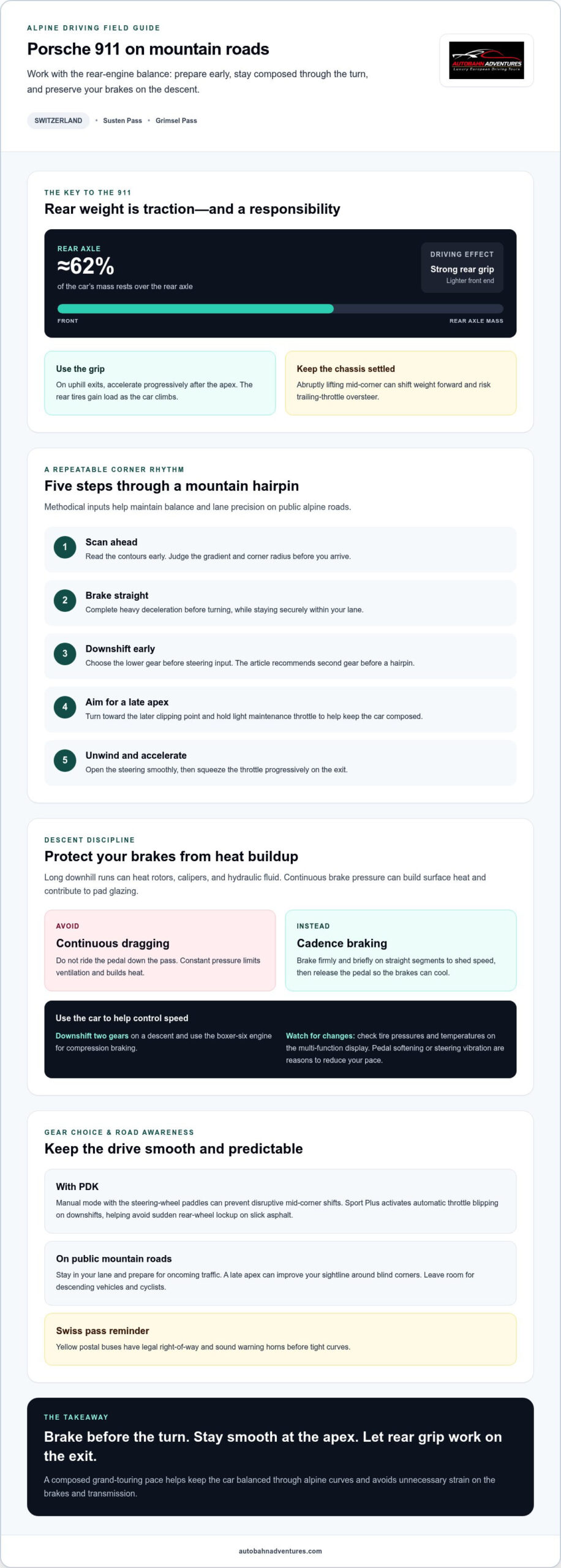
A Porsche 911 behaves unlike any other sports car when carving alpine switchbacks. With roughly 62% of its mass resting over the rear axle, this iconic architecture shapes every cornering phase. That rear bias delivers unmatched traction, but it also creates a lighter front end that requires deliberate steering inputs to load the front tires before turn-in. Lifting off the throttle abruptly mid-corner transfers weight forward instantly, risking sudden trailing-throttle oversteer. Balanced throttle maintenance through the apex generates immense rear mechanical grip on corner exit. Because the engine sits behind the rear axle, the 911 pendulum effect demands steady throttle delivery so the car’s shifting momentum works with you rather than against you.
Managing Weight Transfer and the Pendulum Effect
Alpine descents leave no margin for an unsettled chassis. Mastering fundamental tips for driving a porsche 911 on mountain roads begins with deliberate braking discipline:
- Brake straight: Complete all heavy deceleration in a straight line before turning the wheel.
- Trail-brake lightly: Feather off the pedal gently to keep the front tires loaded without unweighting the rear axle.
- Avoid mid-corner lift-off: Maintain steady maintenance throttle to keep the chassis composed across negative-camber bends.
Harnessing Rear Traction on Steep Uphill Sweepers
Steep climbs showcase the true genius of rear-engine engineering. Accelerating uphill shifts vehicle weight directly onto the rear tires, producing relentless mechanical grip out of tight hairpins. Squeeze the throttle progressively once you clip the apex, powering out without hesitation or rear slip. If your vehicle features rear-axle steering, it will neatly pivot the car around tight radius curves. That agility reduces the need for aggressive steering angles. Applying these tips for driving a porsche 911 on mountain roads turns challenging gradients into effortless, confidence-inspiring touring.
Step-by-Step Technique: Navigating Alpine Switchbacks and Hairpin Turns
Carving tight mountain hairpins requires methodical execution rather than track-day aggression. Racing circuits invite drivers to use the entire curb, but public alpine roads demand absolute lane precision. Executing this deliberate five-step sequence ensures both pace and composure through every turn:
- Scan ahead: Read the mountain contours early to gauge gradient shifts and corner radius.
- Brake straight: Scrub off speed decisively in a straight line while remaining securely within your lane.
- Downshift early: Select the ideal lower gear before initiating any steering input.
- Target a late apex: Rotate the Porsche toward the later clipping point while holding light maintenance throttle.
- Unwind and accelerate: Smoothly open the steering wheel as you progressively squeeze the throttle onto the exit straight.
Following this rhythm provides essential tips for driving a porsche 911 on mountain roads without upsetting vehicle balance.
Lane Discipline on Blind Mountain Corners
Never treat a public alpine pass like a private racetrack. Crossing the center line invites dangerous surprises, especially along rock walls that obstruct forward vision. Adopting a late apex expands your sightline around sheer cliffs while keeping your wheels firmly inside your travel lane. Be prepared for oncoming traffic at all times. On narrow Swiss passes, yellow postal buses hold legal right-of-way and sound warning horns before tight curves. Always leave ample room for descending vehicles and cyclists.
Downshifting and Engine Braking with PDK or Manual
Steep ascents and descents reward proactive gear selection. Shift into second gear before entering a hairpin to keep the engine in its optimal torque band for corner exit. If you drive a Porsche Doppelkupplung (PDK), engage manual mode with the steering wheel paddles to prevent disruptive mid-corner shifts. Selecting Sport Plus activates automatic throttle blipping on downshifts. This precise rev-matching prevents sudden rear-wheel lockup on slick asphalt. If you want to refine these skills on breathtaking European passes, you can reach out to our travel specialists to learn about our 2027 driving itineraries.
Brake Management and Downhill Descents: Preventing Fade and Heat Buildup
Descending an alpine pass tests vehicle brakes more than almost any track session. Extended downhill runs trap intense thermal energy inside rotors, calipers, and hydraulic fluid lines. Dragging the brakes continuously creates pad glazing and boils fluid quickly. To preserve stopping power, downshift two gears and let the boxer-six engine provide natural compression braking. Monitor tire pressures and temperatures via your multi-function display, as hub heat can alter cold tire pressures rapidly.
Cadence Braking Versus Continuous Dragging
Never ride the pedal down an alpine descent. Continuous light pressure prevents ventilation and builds extreme surface heat. Instead, apply firm, brief cadence braking down straight segments to shed speed quickly, then release the pedal entirely. This technique lets mountain air rush through the cooling ducts. If you notice pedal softening or slight steering vibration, reduce your pace immediately to let the braking system recover.
PCCB Ceramic Versus Cast-Iron Brake Care
Standard cast-iron rotors deliver tremendous stopping authority, but they require steady cooling cycles to prevent micro-cracking under repetitive downhill loads. Porsche Ceramic Composite Brakes (PCCB) offer unmatched resistance to fade, yet they still need continuous airflow to clear residual heat. When pulling off to admire a mountain vista, never set the electronic parking brake immediately after a spirited run. Clamping hot pads onto scorching rotors can easily distort contact surfaces.
Adapting Driving Modes for Wet or Cold Mountain Asphalt
Weather shifts rapidly at high altitudes. Switch to Porsche Wet Mode the moment you encounter sudden rain runoff or shaded snowmelt across the road. Mountain summits often bring abrupt temperature drops that reduce the mechanical grip of ultra-high-performance summer tires. Honing these thermal habits ranks among the most valuable tips for driving a porsche 911 on mountain roads. Discerning travelers who embark on our curated driving holidays master these high-altitude passes with effortless support. To secure your preferred sports car on our luxury European routes, reserve your 2027 driving tour today.
The Grand Touring Reality: Putting Skills into Practice on Iconic Passes
Testing your chassis control on paper is one thing, but applying practical tips for driving a porsche 911 on mountain roads in the Swiss Alps is pure exhilaration. The legendary trio of the Susten, Grimsel, and Furka Passes forms a 131-kilometer loop with more than 3,840 meters of elevation change. Navigating this majestic terrain requires balancing spirited performance with scenic appreciation. Independent drivers often battle grueling traffic bottlenecks, navigation stress, and physical fatigue. Experiencing these high-altitude passes behind the wheel of a perfectly prepared Porsche 911 turns demanding tarmac into pure driving bliss.
Mastering the Swiss Pass Trio: Susten, Grimsel, and Furka
Each alpine pass presents a distinct physical rhythm. Susten Pass delivers sweeping curves and carved stone tunnels, allowing you to settle into higher gears with unflinching composure. Grimsel Pass demands surgical precision as you navigate exposed granite landscapes, technical hairpins, and sharp gradient changes. Furka Pass tests your lane discipline against sheer cliff faces and famous switchbacks where consistent eyes-up scanning keeps the car poised.
Why Fully Curated Grand Tours Elevate the Mountain Driving Experience
Curated journeys remove the logistical headaches of alpine touring. You never have to worry about route mapping, road closures, or luggage management. Instead, you enjoy flawless days on open ribbons of asphalt followed by restful evenings at premier five-star hotel retreats. Autobahn Adventures has perfected luxury European travel for 22 years since our founding in 2004. Our journeys depart from Mainz, offering an inspiring stop at the Porsche Museum in Stuttgart before climbing toward alpine summits.
With all 2026 departures completely sold out, forward planning ensures you secure your spot. Explore our extraordinary luxury 2027 driving tours to claim your preferred seat. Porsche 911 sports cars are allocated strictly by registration and deposit date, making early booking a true advantage. You can also read inspiring firsthand stories from our passionate guests who transformed technical tips into lifelong alpine memories.
Command the High Passes with Absolute Composure
Mastering rear-engine balance transforms alpine motoring from an intimidating challenge into pure grand touring art. Applying disciplined straight-line deceleration, smooth cadence braking down steep descents, and patient throttle past the apex lets you work in complete harmony with the chassis. These proven tips for driving a porsche 911 on mountain roads ensure you won’t feel unsettled when navigating technical hairpins.
For 22 years since 2004, Autobahn Adventures has delivered extraordinary European driving vacations. Our guests command pristine Porsche 911 sports cars along storied roads, supported by seamless luggage logistics and handpicked five-star alpine accommodations. Because our 2026 season is completely sold out, early reservations are essential to guarantee your preferred sports car allocation. Begin planning your 2027 European Porsche adventure today and experience the world’s greatest mountain passes with supreme luxury and total peace of mind.
Frequently Asked Questions
How does driving a rear-engine Porsche 911 differ from a front-engine car on mountain roads?
A rear-engine Porsche 911 places over 60% of its weight over the rear axle, creating massive rear traction out of corners compared to front-engine cars. However, this architecture also makes the front axle lighter. You need deliberate trail-braking to load the front tires before initiating a turn. Following tailored tips for driving a porsche 911 on mountain roads lets you turn that rear weight bias into unmatched climbing grip.
Should I keep Porsche Stability Management (PSM) fully active on mountain passes?
Yes, you should keep Porsche Stability Management fully active on public mountain passes. Narrow alpine passes feature blind bends, fluctuating gravel, and unexpected damp patches where sudden traction loss can happen. Modern PSM calibrations in Sport mode allow subtle chassis rotation without compromising safety. Deactivating PSM on roads without runoff areas adds unnecessary risk. The system acts as an imperceptible safety net, preserving total vehicle composure.
What is the safest gear selection technique when descending steep mountain switchbacks?
The safest gear selection technique is locking the transmission into second or third gear before entering steep descents. Using manual paddle mode prevents the PDK gearbox from upshifting unexpectedly downhill. Lower gears harness natural engine compression braking from the boxer-six engine, which significantly reduces the thermal workload on your calipers and rotors. Never coast down descents in neutral, as you lose immediate throttle response and engine deceleration.
Can you safely drive a Porsche 911 on alpine passes in wet weather?
Yes, a Porsche 911 navigates wet alpine passes with supreme stability when you activate Porsche Wet Mode. Acoustic sensors inside the front wheel wells detect water spray and prep stability control, anti-lock braking, and drivetrain response for slippery tarmac. To remain secure, avoid painted road markings, steer smoothly, and reduce corner entry speeds. Respecting changing weather conditions is one of the most essential tips for driving a porsche 911 on mountain roads.
How do I avoid brake fade when driving down long mountain descents?
You avoid brake fade by cadence braking firmly down straight stretches and relying heavily on engine braking. Continuous light pedal pressure traps immense heat inside the rotors, which glazes pads and boils brake fluid. Instead, squeeze the pedal decisively to scrub off speed, then release it completely. This allows cold mountain air to rush through the brake cooling ducts, preserving stopping power throughout multi-pass descents.
Why is an all-inclusive luxury tour the best way to experience European mountain driving?
An all-inclusive tour eliminates the stress of navigation, traffic planning, and luggage logistics, letting you focus purely on the drive. Autobahn Adventures provides pristine Porsche 911 sports cars and handpicked five-star hotel retreats backed by 22 years of operational excellence. You explore iconic routes like the Susten, Grimsel, and Furka Passes with complete peace of mind. Reserving your 2027 itinerary early guarantees priority Porsche vehicle allocation from our Mainz departure base.